October 26, 2026
Custom Pins, Dowels & Ferrules: Solving Electromechanical Assembly Challenges
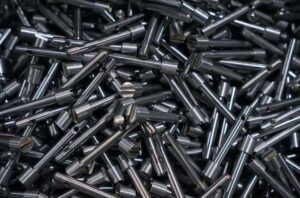
Pins, dowels, and ferrules are the parts nobody talks about until one fails. They locate components, carry signal and current, secure cable, and hold assemblies in alignment. On paper they look like the simplest things a shop makes: a turned diameter, maybe a chamfer, a length cut to spec. In practice, these small turned parts carry tight functional requirements, and the details that seem minor on the print are exactly the ones that decide whether an electromechanical assembly goes together cleanly and performs in the field.
This guide covers the real challenges behind custom pins, dowels, and ferrules, and what to specify so the part works the first time and every time after.
Small parts, serious requirements
An electrical dowel pin that locates a connector housing, a ferrule that terminates a cable, a contact pin that has to press-fit and conduct: each lives inside an assembly where fit and repeatability matter more than headline dimensions. A few thousandths of runout, a burr at a lead-in, or a plating thickness that drifts between lots can turn a press-fit into a reject or a reliable contact into an intermittent one.
Three characteristics tend to drive success: concentricity and roundness on the working diameters, clean and consistent lead-in geometry, and controlled surface condition for plating and conductivity. Get those right and the part installs predictably and performs reliably.
Concentricity: the dimension that decides the fit
For a pin or dowel that locates, guides, or press-fits, concentricity between diameters is often more important than any single diameter value. If the working diameter wanders relative to its reference, the part can bind on insertion, seat crooked, or wear unevenly in service. Roundness and straightness matter just as much on slender pins, where a small bow becomes a real alignment problem.
This is where Swiss-type turning earns its keep. By supporting the workpiece with a guide bushing right at the cutting zone, a Swiss lathe holds concentricity and straightness on long, thin parts that would deflect or chatter on a conventional lathe. At McCormick Industries, that means tolerances as tight as ±.0001″ in diameter, length, and roundness, held consistently across a production run rather than on a lucky first piece.
Lead-ins, chamfers, and burr-free edges
The geometry at the end of a pin does a lot of quiet work. A properly formed chamfer or radius lets a pin start straight and seat without shaving material or damaging a bore. A burr left at that lead-in, or at a cross-hole or slot, can scrape a plated surface, prevent full insertion, or break loose and contaminate an assembly. For parts that press-fit or carry current, edge condition is a functional requirement, not a cosmetic one. Disciplined micro-deburring and finishing keep those edges clean where it counts.
Plating and surface condition: coordinate it, don’t bolt it on
Many electromechanical parts are plated for conductivity, corrosion resistance, or wear: tin, nickel, gold, zinc, and others. The catch is that plating adds thickness, and that thickness lands on top of your machined dimension. If the as-machined size and the plating allowance are not planned together, a part that measured perfectly bare can end up out of tolerance once it’s plated.
The reliable approach is to coordinate machining and plating as one process, accounting for build-up on critical diameters up front and confirming how the finish interacts with the base material. McCormick manages these outside processes as part of its value-added services, so the plated, finished part arrives to print rather than to the bare dimension. Consolidating machining and finishing under one partner also removes handoffs that add lead time and risk.
Lot-to-lot consistency at volume
Pins, dowels, and ferrules are usually high-count parts. The question is rarely whether a shop can make one good piece; it’s whether piece 50,000 matches piece one. Consistency at that scale is a process-control problem, and it’s where lights-out, unattended machining pays off: a proven, monitored process that holds dimensions and finish across long runs while keeping per-part cost down. For buyers, that consistency is what keeps a line running without incoming-inspection surprises.
A short checklist for custom pins, dowels, and ferrules
Before your next small turned part goes out for quote:
- Is concentricity (and roundness/straightness) called out on the working diameters, not just the diameters themselves?
- Are lead-in chamfers or radii specified where the part inserts or press-fits?
- Are deburring and edge-break requirements explicit?
- Does the print state whether dimensions apply before or after plating, with the plating allowance accounted for?
- Is the plating type matched to the conductivity, corrosion, and wear needs of the application?
- Does the expected volume call for a process proven to hold consistency lot to lot?
Simple parts, done right
The parts that look simplest are often the ones where sourcing discipline matters most, because small errors multiply across thousands of assemblies. With 30 years of precision machining experience, ISO 9001:2015 certification, Swiss capability built for small turned parts, and value-added finishing and plating coordination under one roof, McCormick Industries helps electromechanical manufacturers get pins, dowels, and ferrules that fit, conduct, and hold up.